
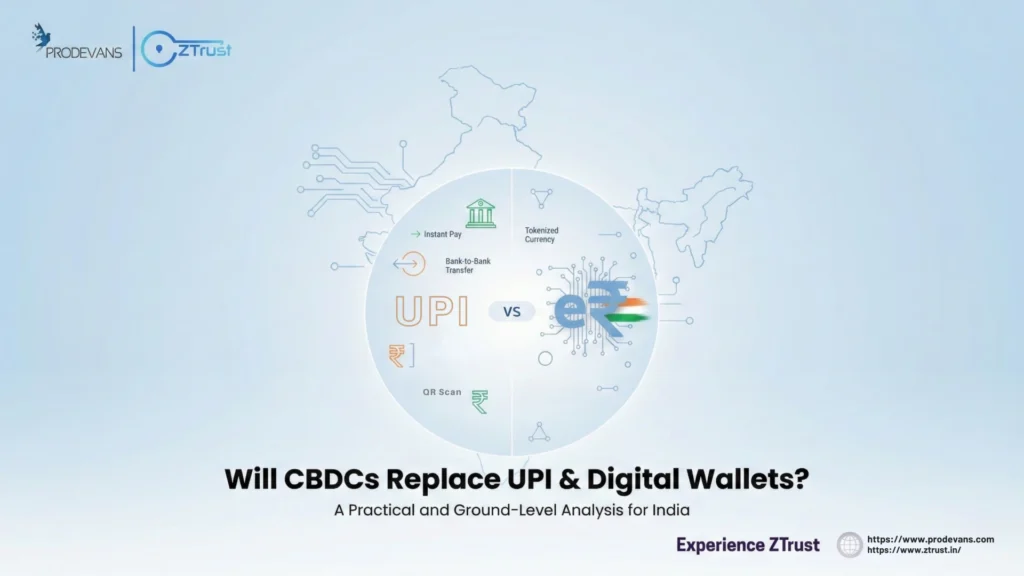
A Practical and Ground-Level Analysis for India
India has spent the last decade building one of the strongest digital payment ecosystems in the world. UPI has become a household name, digital wallets have found their space in everyday payments, and fintech adoption has grown faster than anyone predicted.
Now, with the arrival of the Digital Rupee (e₹)—India’s Central Bank Digital Currency—the natural question many are asking is:
“Will CBDCs eventually take over UPI and digital wallets?”
From our position at Prodevans, where we work closely with financial institutions adopting CBDC infrastructure, the answer isn’t a simple yes or no—it’s layered and evolving. Understanding this shift requires looking at what each system actually does and why CBDC introduces something fundamentally new into the picture.
UPI, Wallets, and CBDC: They’re Not the Same Thing
While all three may look similar from a user’s perspective, what happens underneath is very different.
UPI: India’s Digital Rail
UPI connects banks and allows money to move instantly from one account to another. The money being transferred is commercial bank money, not digital cash.
Digital Wallets: A Storage Layer
Wallets like Paytm Wallet or Amazon Pay store prepaid balances. Again, these balances come from commercial banks and are simply held in a different type of account.
CBDC (Digital Rupee): A New Kind of Money
This is where the big shift happens.
CBDC is actual digital currency issued by the RBI, similar to physical cash but in a secure digital form.
It doesn’t represent a bank liability—it is the currency itself.
This difference alone sets CBDC apart from UPI and wallets.
Why CBDC Works Differently Under the Hood
India’s CBDC runs on a two-tier model:
Tier 1 – The RBI
- Issues digital tokens
- Maintains the core ledger
- Manages nodes and system controls
- Handles data insights and security
Tier 2 – Banks and Technology Partners
This is where institutions like Prodevans come in.
Participating banks and their technology partners—like Prodevans—manage:
- CBDC wallets
- eKYC and AML checks
- Transaction monitoring
- Reporting
- API integrations with existing systems
In simpler words, CBDC introduces a new sovereign layer in India’s digital economy—something UPI never aimed to do.
Will CBDC Replace UPI? Most Likely, No
There has been a lot of speculation about this, but the two are built for different purposes.
UPI Moves Money
It’s an extremely efficient system that rides on existing bank accounts.
Nothing changes about how money is defined.
CBDC Is Money
It’s programmable, it settles instantly like cash, and it eliminates multiple back-end processes.
Both systems can easily co-exist because they solve different problems.
Where CBDC Adds Real Value
- Cash-like finality
- Lower cost for large transaction volumes
- Offline transactions
- Better transparency
- Ability to embed rules (programmability)
Where UPI Continues to Dominate
- Habit and adoption
- Merchant acceptance
- Simplicity
- Seamless bank-to-bank transfers
UPI is not going anywhere. Instead, CBDC brings a new option—digital cash that works alongside India’s existing rails. Rather than competing, UPI and CBDC will coexist—each excelling in areas where the other reaches its limits.
Will CBDC Replace Digital Wallets? This Is More Likely
Digital wallets may feel more pressure over time. Here’s why:
- Wallet balances represent money stored with commercial banks.
- CBDC wallets represent actual RBI-issued money.
- CBDC wallets can integrate with rails like NPCI and bank platforms without added layers.
- Merchant fees and settlement costs could be lower with CBDC.
As adoption grows, the natural shift may move from prepaid wallets to CBDC wallets.
Digital wallets won’t vanish overnight, but their purpose may evolve as CBDC wallets mature.
A Hybrid Future: CBDC + UPI + Bank Systems Working Together
India’s financial ecosystem is designed to grow in layers, not silos.
The architecture clearly shows:
- CBDC wallets issued by banks
- NPCI facilitating transaction routing
- UPI applications possibly integrating Digital Rupee flows
- Banks acting as intermediaries between users and the RBI
The direction is clear:
India is moving towards a system where sovereign digital money and existing digital rails complement each other.
CBDC as a Service: How Prodevans Fits Into This Story
Prodevans have been an integral part of India’s CBDC journey—from pilot to production.
This anchors authority before listing offerings.
Prodevans Delivers:
- Modular, cloud-ready CBDC infrastructure
- Wallet creation and token lifecycle management
- API and NPCI integration
- Real-time AML/CFT monitoring
- 24×7 operational and ledger support
Because we’ve been deeply involved in India’s CBDC journey, we understand both the technical and regulatory expectations.
Our role is to make the transition smooth for banks, so they can confidently serve millions of users with the Digital Rupee.
Looking Ahead: What India Can Expect
In the next few years, India’s payment ecosystem is likely to evolve as follows:
- UPI will stay the primary rail for bank transfers.
- CBDC (e₹) will gradually become the digital equivalent of cash—especially for programmable, low-cost, regulated use cases.
- Digital wallets may see reduced dependency as CBDC wallets become more common.
CBDC isn’t here to replace everything—it’s here to strengthen India’s financial foundation.
At Prodevans, we’re proud to be part of this transformation, helping institutions, banks, and regulators embrace a future-ready, sovereign digital economy.